
What Are Evidence Handling Exercises?
At Maryman & Associates, we know that law enforcement, corporate investigators, and digital forensic teams all rely on precise and reliable practices when managing evidence. Evidence handling exercises are dynamic, scenario-driven trainings that simulate real-world situations where professionals practice the responsible collection, preservation, documentation, and transfer of various forms of evidence. Whether the focus is on physical evidence at a crime scene or digital artifacts from a network breach, these exercises allow our teams to hone their skills in a risk-free environment. By emphasizing structured protocols and requiring strict adherence to chain of custody, evidence handling exercises are crucial in ensuring the integrity of all investigations.
In the constantly evolving landscape of digital and physical crime, these training scenarios are far more than simple drills-they form the backbone of our approach to credible investigations, legal compliance, and courtroom success. When these skills are practiced and refined, the resulting procedures are less likely to falter under pressure-ultimately protecting the evidence and the case itself. Contact us to discuss how customized evidence handling exercises can support your organization’s needs.
Why Practice Evidence Management Skills?
Meticulous evidence management is essential for any investigation. Simulated handling situations give our team the opportunity to practice, critique, and improve upon crucial protocols in a real-time setting. With advances in technology, new evidence types like mobile devices, cloud storage, and IoT artifacts have introduced novel challenges. Practicing our evidence management skills ensures we remain ahead of these challenges, whether our focus is on digital device forensics, GPS and mobile data, or physical items.
Beyond the technical aspects, evidence handling simulations build confidence and responsibility among staff. Mistakes made during training reveal gaps, which can then be addressed proactively rather than reactively. Effective management also reduces the potential for chain of custody breaks, lost data, or compromised investigations. By engaging repeatedly in these realistic exercises, we help all members of our investigative teams understand both the theoretical and practical implications of each action they take during evidence collection.
Moreover, these exercises provide a foundation for collaboration, ensuring that digital forensics investigators, incident response teams, and analysts all work seamlessly together. Our clients count on us to provide trustworthy, well-documented findings-something only possible when evidence is handled flawlessly from start to finish.
The Basics of Chain of Custody Training
No evidence handling exercise is complete without a focus on chain of custody training. The chain of custody is the documented journey of evidence through every handler, location, and transaction from collection to courtroom. In every scenario, we stress the absolute necessity of recording every step-ensuring we can account for each item, prove authenticity, and maintain credibility if ever called to testify.
Our exercises begin with simulated evidence discovery. We emphasize clear notation of the time, date, and identity of the person first encountering the item. Next, our teams record all handling activities, using both standardized digital logs and physical logs when needed. We integrate best practices laid out by sources such as the NIST Digital Evidence Preservation guide to reinforce internationally recognized standards.
Chain of custody failures can result in evidence being deemed inadmissible in court. During our evidence handling exercises, we challenge participants to spot potential weak links-like incomplete documentation or unsupervised transfers. Through this process, our staff internalizes the seriousness of chain of custody management and refines their attention to detail.
For digital evidence, this process is even more complex. Devices must be secured, imaged, and logged with hashes and proper metadata. Our courses use scenarios involving everything from seized laptops to smartphone extractions and cloud account preservation, emphasizing continuity and security with every transfer.
Step-by-Step Guide to Evidence Handling Exercises
Effective evidence handling exercises require both planning and adaptability. We design our drills to replicate the varied environments our teams may face-from field collection to lab intake and courtroom presentation. Here’s an overview of the process our training scenarios follow:
- Preparation: Define objectives, assign roles (collector, observer, evidence custodian), and outline potential evidence types to be used (physical, digital, hybrid).
- Scenario Launch: Introduce the scenario, typically involving an incident or mock crime that requires collection and preservation. This may involve different settings-a corporate office, outdoor crime scene, or a remote network breach.
- Evidence Collection: Use appropriate tools to collect evidence while maintaining safety, security, and preventing contamination. For digital evidence handling simulations, we may include acquisition of mobile devices, removable media, IoT artifacts, or cloud accounts. Referencing our IoT digital device forensics and GPS and mobile forensics services, we design realistic activities based on our current casework and real trends.
- Documentation: All actions are meticulously recorded, including photographs, written logs, timestamped entries, and digital chain of custody forms.
- Transfer/Transport: Evidence is packaged, labeled, and moved to a secured lab or storage, with transfer logged by both parties. For digital evidence, this step often includes secure uploading, hashing, and storage in forensically sound containers.
- Review and Debrief: Teams describe their actions, critique each other’s technique, and trainers provide feedback on strengths and weaknesses. This learning loop is what enables continuous improvement in our practices.
By repeating and refining these steps, our team members become adept at handling evidence confidently and reliably, regardless of the investigative challenge at hand. For those looking to specialize in more advanced digital evidence, we recommend exploring our digital forensics investigator and digital forensics incident response programs to accelerate expertise.
Common Mistakes in Evidence Handling Simulations
Training exercises help uncover frequent errors that could otherwise jeopardize an actual investigation. In our experience, some of the most common issues identified during evidence handling exercises include:
- Improper or incomplete documentation: Missing signatures, times, or item descriptions can create chain of custody gaps.
- Inadequate packaging: Failing to use tamper-evident bags or correct containers for sensitive evidence (such as electronics or biological samples).
- Contamination or mishandling: Handling evidence with bare hands or not following cross-contamination protocols, especially with physical and trace evidence.
- Failure to secure digital evidence: Not immediately isolating network connections or neglecting to capture volatile memory and metadata before shutting down a system.
- Poor communication between handlers: Not briefing the next custodian or failing to document handovers properly.
By mimicking investigative pressures in a low-risk environment, we ensure our professionals identify and correct bad habits before facing them in the field. These exercises also serve as an opportunity to integrate feedback and adapt our protocols to address emerging threat vectors and evidence types.
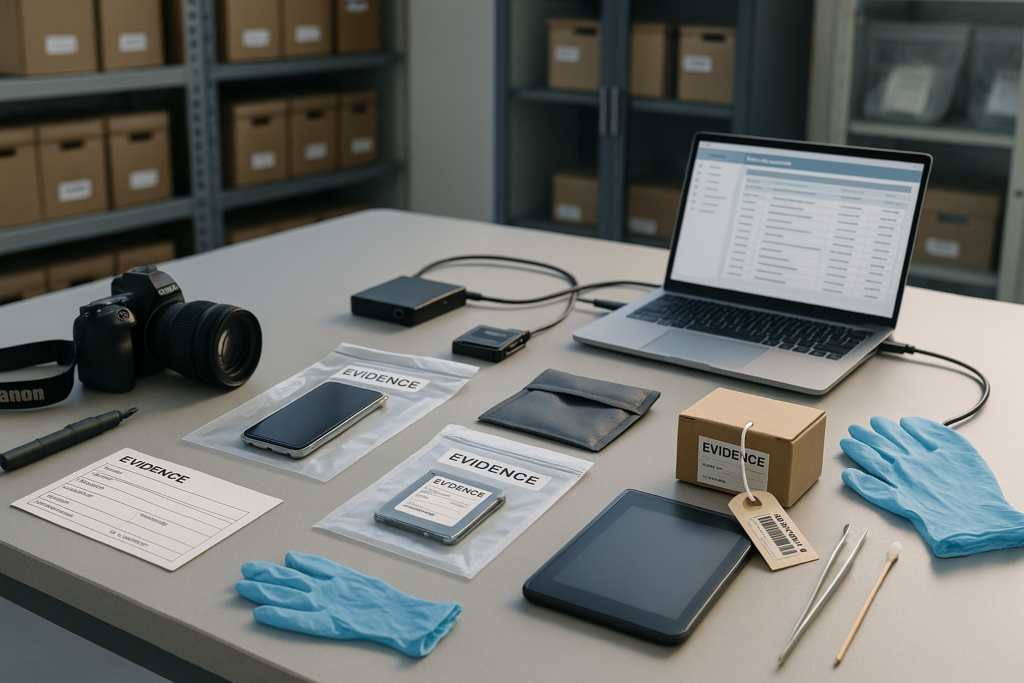
Tools Used During Evidence Collection Practice
Our evidence handling exercises leverage a range of tools and supplies to mirror real-world conditions. Depending on the simulated scenario, our teams employ:
- Gloves, tweezers, and swabs for biological and trace evidence
- Tamper-evident bags, envelopes, and evidence tags for physical artifacts
- Cameras and video recorders for dependable scene documentation
- Write blockers, imaging devices, and forensic duplicators for digital data
- Hash generation software and chain of custody digital logbooks
- Specialized containers to shield electronics from wireless interference (Faraday bags, anti-static bags)
- Labeling systems to prevent mix-ups between evidence samples
Integrating these tools into our routine ensures smooth transitions during real collections. As new evidence types emerge-from IoT devices to cloud-based platforms-we continually evaluate and update our equipment to stay ahead of technological advances. Our team’s familiarity with these tools is critical for rapid, accurate, and court-defensible actions at the point of evidence recovery.
Improving Outcomes with Evidence Handling Drills
Well-structured evidence handling exercises provide measurable benefits. First, they reduce the risk of evidence mishandling, protecting both the investigation and the reputations of everyone involved. Through hands-on learning, our staff develop muscle memory, speeding up processes without sacrificing attention to detail. Repetitive exposure to a variety of scenarios-from routine searches to high-stress incident response-ensures that when real situations arise, our professionalism remains uncompromised.
Additionally, these drills strengthen communication skills and clarify role responsibilities, minimizing confusion in interdisciplinary investigations. They also encourage both individual accountability and team-based problem-solving, which are vital when handling large volumes of evidence, or investigating incidents involving emerging technologies. We routinely debrief after each exercise, gathering insights that inform and improve our ongoing training, services, and even products offered to our clients.
For clients seeking heightened assurance and legal defensibility, our investment in regular evidence handling exercises translates into reliable results, complete documentation, and peace of mind. Connect with our team to learn more about how we can help your organization optimize its evidence workflow and prevent avoidable mishaps.
Tips for Effective Evidence Procedure Training
Maximizing the value of evidence handling simulations requires thoughtful planning and continuous reassessment. Our top recommendations for effective evidence handling exercise training include:
- Vary the scenarios: Incorporate physical, digital, and hybrid evidence to keep teams versatile.
- Emphasize chain of custody: Every participant should understand its significance and how to avoid common pitfalls.
- Leverage technology: Use modern tools for documentation, imaging, and security.
- Roleplay from discovery through courtroom: Include testifying as an expert to reinforce why meticulous evidence handling matters.
- Debrief comprehensively: Review both mistakes and successes, and solicit input from all participants to foster a culture of learning.
- Keep policies current: Integrate the latest industry standards and legal guidance from sources like NIST into your protocols.
By integrating these principles, we ensure that our evidence handling exercises achieve not just compliance, but true investigative excellence-strengthening confidence at every link in the investigative chain. If you’d like to know more about our training modules, please reach out for a free consultation.
Continuous Improvement in Evidence Handling Exercises
One of the hallmarks of our approach at Maryman & Associates is a commitment to continuous improvement. We believe that regular review and adaptation are essential for maintaining robust evidence handling procedures. Following each set of evidence handling exercises, we analyze team performance, adjust protocols to address discovered weaknesses, and incorporate lessons learned into future trainings.
This iterative process is critical as technology changes and legal requirements shift. We frequently update our evidence handling exercises to factor in new developments, such as advanced encryption, mobile device trends, remote device collections, and evolving standards in digital evidence preservation. Our commitment to ongoing improvement not only benefits our internal team, but also empowers us to deliver exceptional results to our clients and partners-whether the needs involve traditional physical evidence or complex digital artifacts.
If your organization is interested in enhancing its evidence collection, preservation, and management, partner with Maryman & Associates. Our comprehensive, hands-on approach to evidence handling exercises can help your team stay prepared no matter what challenges arise.
Ready to strengthen your investigative outcomes? Contact us today to schedule a consultation, discuss custom scenario development, or arrange a demonstration of our evidence handling exercises. Together, we can ensure that your cases are handled with confidence, care, and absolute integrity from start to finish.
FAQ
What are evidence handling exercises?
Evidence handling exercises are practical training activities designed to help professionals learn how to securely collect, document, and preserve evidence. At Maryman & Associates, we develop these exercises to mirror real-world scenarios, ensuring participants gain hands-on experience. Such training not only builds confidence but also improves compliance with legal protocols.
Why is chain of custody training important?
Chain of custody training teaches experts how to track evidence from collection to courtroom. For example, it ensures accountability at each step, so evidence remains credible. By mastering these skills, teams minimize risks of contamination or loss, which can dramatically impact case outcomes.
What are common mistakes in evidence handling simulations?
Common errors include improper documentation, forgetting to seal containers, or mislabeling items. In addition, some may overlook critical details during collection or transport. Through our simulations, we help participants identify and correct these mistakes, enhancing their attention to detail.
Which tools are most effective for evidence collection practice?
We use a variety of tools such as evidence bags, seals, tamper-evident tape, and digital documentation devices. Moreover, practicing with authentic equipment makes training more realistic. This approach prepares individuals for the challenges they’ll face during actual investigations.
How can teams continuously improve their evidence handling skills?
Continuous improvement comes from regularly scheduled drills, feedback sessions, and updated protocols. By reviewing performance after each exercise, participants can promptly address weaknesses. In addition, Maryman & Associates recommend staying updated with the latest advancements and legal changes for optimal results.