
Understanding Drone Flight Log Forensics
Drone flight log forensics is the systematic process of collecting, analyzing, and interpreting data generated during the operation of unmanned aerial vehicles (UAVs). At Maryman & Associates, we leverage our expertise to help organizations, attorneys, and investigators unravel complex incidents by examining flight logs. These records contain a wealth of information-ranging from GPS coordinates and flight paths to system alerts and pilot inputs. With drones now integral to fields like logistics, agriculture, public safety, and even hobbyist communities, the role of drone flight log forensics has never been more critical. A robust understanding of this field empowers us to reconstruct flight events, assess operator intent, and provide factual insights in disputes or investigations.
Why Drone Flight Data Analysis Matters
As practitioners in digital and IoT device forensics, we recognize the expanding influence of drones in commercial, governmental, and private sectors. Drone flight data analysis plays an essential role in post-incident reviews-whether we are clarifying the circumstances of an aerial accident, confirming lawful flight paths, or identifying pilot actions in potential trespassing or violation events. The accurate investigation of UAV flight logs supports legal compliance, enhances operational safety, and helps organizations safeguard their reputations. Drone flight log forensics provides objective evidence that often becomes the cornerstone of litigation, insurance claims, regulatory inquiries, or internal compliance checks.
Furthermore, as drones integrate with smart infrastructure and GPS systems, the lines between UAV, IoT, and mobile forensics are increasingly interconnected. Our experience in digital device forensics and IoT digital device forensics enhances our ability to holistically approach UAV flight data investigations, ensuring that no relevant evidence is overlooked.
Essential UAV Forensic Terms and Concepts
To navigate drone flight log forensics proficiently, we must understand the vocabulary and concepts unique to this discipline. Here are some key terms:
- Flight Logs: Digital files automatically generated by UAVs, documenting diverse parameters such as altitude, position, battery health, compass heading, propeller speed, and pilot controls.
- Telemetry: Real-time or recorded data that tracks the drone’s status, movement, and environmental readings throughout its operation.
- Waypoints: Pre-programmed GPS coordinates establishing a drone’s route, crucial for mapping flight paths and reconstructing journeys.
- Black Box Data: Similar to aviation flight recorders, this term refers to secure or protected information sources-sometimes embedded in UAVs-that can provide vital post-incident insights.
- Data Integrity: The assurance that recovered data remains unchanged, helping to ensure evidence admissibility in legal forums.
With rapid advances in drone hardware and software standards, we are vigilant about jargon adaptation and platform-specific conventions, enabling precise forensic analysis no matter the device brand or model.
Recovering and Analyzing Drone Flight Logs
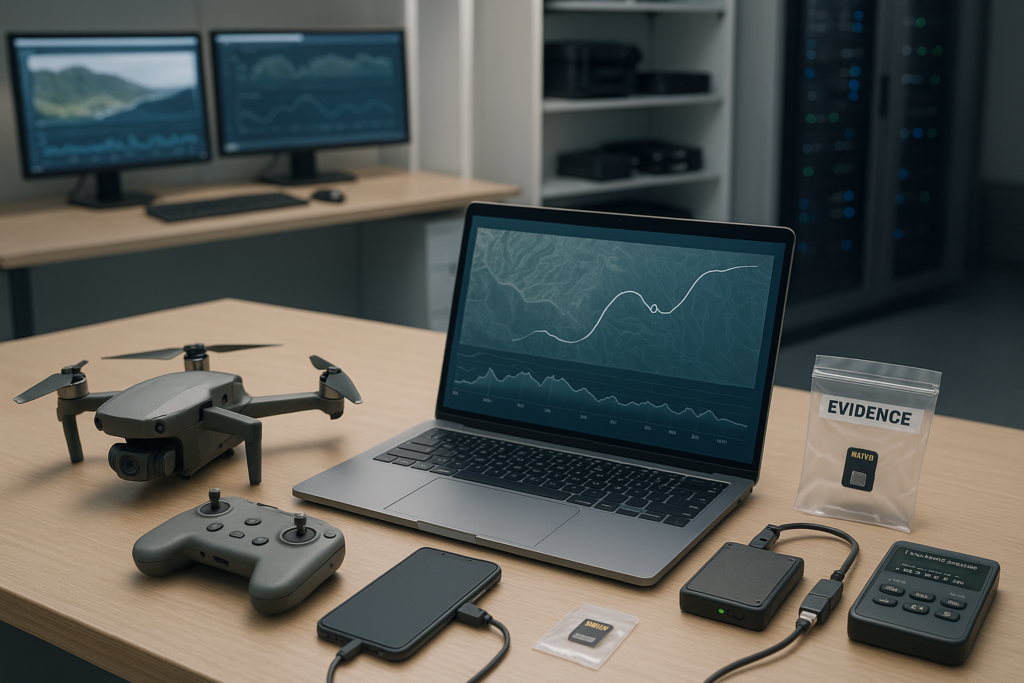
The effectiveness of drone flight log forensics hinges on comprehensive data recovery and precise analysis. Our investigative process typically begins by identifying and isolating relevant devices, such as onboard UAV memory cards, remote controllers, mobile apps, or associated cloud accounts. Modern UAV platforms often store logs locally in encrypted or proprietary formats, which can demand specialized techniques for secure extraction.
Steps in Drone Flight Log Data Recovery
We approach data recovery methodically:
- Device Identification: Locating all potential log sources, including the drone itself, operator smartphones, or online sync services.
- Data Imaging: Creating forensically sound copies of storage media to preserve original files and prevent alteration.
- Log Extraction: Using decoding tools and scripts to access UAV flight logs and telemetry data-sometimes overcoming encryption or proprietary roadblocks.
- Metadata Collection: Gathering timestamps, geolocation details, and event markers critical for accurate timeline reconstruction.
Each manufacturer (DJI, Parrot, Autel, etc.) presents unique challenges. Some logs are accessible only via internal apps; others require manual hardware intervention. Our proprietary lab environments and GPS and mobile forensics expertise ensure thorough recovery, while strict chain of custody protocols protect evidentiary value.
Analytical Tools for Drone Flight Log Forensics
Once flight logs are recovered, our forensic analysts employ a combination of industry-leading and proprietary tools for analysis. Software solutions such as DatCon, Airdata UAV, and DroneLogbook, as well as manufacturer-specific applications, help us visualize flight paths, correlate pilot commands with UAV responses, and identify anomalies or system failures.
We may employ hex editors and script-based data parsing for raw log inspection. Visualization tools convert numerical data into interactive maps and timelines, supporting easier interpretation by legal teams or stakeholders. Each forensic investigation may require a tailored blend of open-source platforms and commercial software, guided by the objectives of the case at hand.
Our team continuously evaluates emergent resources and guidance provided by standards organizations. For instance, the National Institute of Standards and Technology has provided valuable frameworks, such as those outlined in their UAS forensics guidance, which help standardize investigative methodologies in this evolving landscape.
Ensuring Accuracy, Integrity, and Legal Compliance in Drone Forensics
In every drone flight log forensics case, preserving the accuracy and integrity of digital evidence is paramount. From initial imaging to final reporting, we maintain rigorous documentation-a full audit trail of our actions-so that every step is transparent and reproducible. Adhering to forensic best practices not only strengthens our findings but also supports their admissibility in legal or regulatory proceedings.
Legal implications frequently intersect with technical realities. Questions of consent, privacy, airspace regulation, and liability often emerge during UAV forensic investigations. Our work is informed by the latest FAA guidelines, evolving state legislation, and judicial precedents governing digital device evidence. We emphasize:
- Data validation through cryptographic hashing and cross-referencing of multiple data sources
- Clear documentation showing chain of custody from the moment of evidence acquisition
- Expert testimony services, bridging the gap between technical findings and legal audiences
- Collaborative engagement with law enforcement, regulators, and attorneys to align investigation strategy with legal objectives
If your organization is concerned with compliance issues relating to UAV operations, or you require assistance navigating a regulatory probe, our digital forensics investigator team provides trusted guidance grounded in extensive technical expertise and legal acumen.
Best Practices and Emerging Trends in UAV Flight Data Forensics
As with all digital forensics disciplines, best practices in drone flight log forensics continue evolving to keep pace with technological innovation. We prioritize:
- Immediate preservation of UAVs, controllers, and related apps after incident identification
- Thorough device documentation and secure evidence handling
- Use of vendor-agnostic forensic software to mitigate manufacturer-specific blind spots
- Multi-disciplinary analysis-integrating drone flight data with IoT, GPS, and mobile device evidence where applicable
- Continued education and certifications for our analysts in both drone technology and digital forensic standards
Emerging trends influencing drone flight log forensics include the increased adoption of encrypted flight logs, blockchain-based audit trails for logging, and advanced AI-driven anomaly detection. With UAV fleets now commonly linked to enterprise networks and cloud storage, cross-platform forensic investigations are becoming the norm. We see a future where remote, cloud-based drone data analysis, coupled with real-time alerting and AI forensics, will accelerate both investigative timelines and precision.
At Maryman & Associates, our ongoing engagement with professional forums and continuing research efforts keep us ahead of the curve. We are ready to address complex scenarios-from drone-related intellectual property disputes to critical infrastructure breaches and environmental monitoring incidents. As the landscape shifts, we stand equipped to provide guidance and expert witness support for drone flight log forensic investigations in any setting.
If you need consultation on UAV data analysis or help integrating drone forensics with IoT, GPS, or mobile evidence, contact us today for a confidential case review.
Your Trusted Partners in Drone Flight Log Forensics
Drone flight log forensics is no longer a niche domain. Its value now extends to litigation, accident investigation, law enforcement, insurance assessments, and regulatory affairs. Our cross-disciplinary knowledge in digital, IoT, and UAV forensics ensures your investigation is in skilled hands, regardless of drone model or mission context.
Maryman & Associates delivers forensic services tailored to the evolving demands of modern aerial technologies. From evidence preservation and comprehensive log recovery to expert analysis and clear legal reporting, we support clients at every step of the UAV forensic investigation journey. When precise answers and defensible conclusions matter most, you can rely on our experience and unique methodologies.
Ready to discuss your drone flight data needs, or want to learn how our drone flight log forensics experts can support your next case? Reach out to us now and let our team provide the clarity and confidence you deserve.
FAQ
What is drone flight log forensics?
Drone flight log forensics involves the collection, preservation, and analysis of flight data from unmanned aerial vehicles (UAVs). We utilize specialized tools and techniques to interpret logs, reconstruct flight paths, and uncover key details for legal or investigative purposes. This process helps uncover evidence and clarify incidents involving drones.
Why should you analyze drone flight data during an investigation?
Analyzing drone flight data can provide objective insights into how and when a drone was used. For example, our experts can identify potential causes of accidents or assess operator compliance with regulations. In addition, examining flight logs strengthens the integrity of investigations by offering clear, timestamped records of activity.
What are some essential terms in UAV forensic analysis?
Several key terms frequently arise in UAV forensic analysis, such as GPS coordinates, telemetry data, OSI layers, and log integrity. Understanding these concepts ensures clear communication and accurate analysis. Our team always explains complex terminology so clients can easily follow our findings.
How do experts recover and analyze drone flight logs?
Experts use specialized hardware and software solutions to extract flight logs from drones or cloud servers. After data collection, our analysts validate its accuracy and examine patterns and anomalies. Moreover, robust chain-of-custody methods ensure all evidence remains credible throughout the investigation.
What are the legal implications of drone flight log forensics?
Drone flight log forensics often plays a crucial role in legal proceedings, insurance claims, and compliance checks. Accurate data analysis can support or refute claims of negligence, intrusion, or regulatory violations. Furthermore, adhering to best practices safeguards evidence integrity and supports our clients in legal cases.