
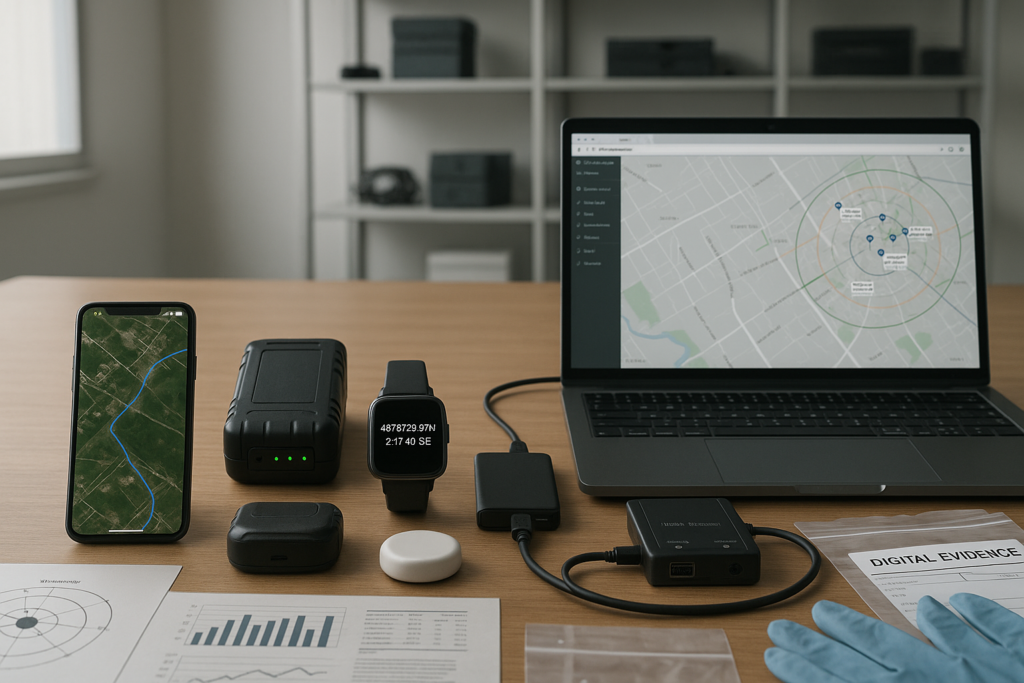
Understanding GPS Evidence in Legal Cases
At Maryman & Associates, we have seen firsthand how GPS evidence accuracy plays an essential role in legal cases. As GPS and location data become prevalent in digital investigations, their entry into courtrooms raises questions about their reliability, precision, and legal weight. The integration of Global Positioning System (GPS) data in litigation-whether in criminal defense, civil matters, corporate disputes, or family law-means that our expertise must keep pace with advancing technology and evolving legal standards.
GPS evidence encompasses location information collected and stored on a wide range of digital devices, such as smartphones, vehicle trackers, wearable devices, and even certain IoT objects. This technology helps reconstruct events, validate alibis, establish timelines, or dispute claims, shaping outcomes for clients across multiple sectors. Yet, leveraging location data requires a nuanced understanding of the science, the potential for error, and the many factors impacting gps evidence accuracy.
The Science Behind GPS Tracking and Location Data
To evaluate GPS evidence, it is critical to first understand how these systems function. GPS technology relies on a constellation of orbiting satellites providing location data to receivers on the ground. Each receiver calculates its position using signals from multiple satellites, determining its latitude, longitude, and sometimes altitude. The result-a so-called “fix”-can be logged as a precise geographical coordinate along with a time stamp. However, gps evidence accuracy in practice depends on several variables, including satellite geometry, signal obstructions, atmospheric interference, and the capabilities of the receiving device.
Most commonly, GPS evidence is extracted from smartphones, vehicle tracking systems, or specialized equipment used in transportation and logistics. Advances in digital device and mobile forensics have made it possible to access historical location records, such as those collected by mobile apps, call detail records, or cloud-based services. Our understanding of gps evidence accuracy is built on the interplay between the hardware collecting the data, the environmental conditions at the time of acquisition, and the software interpreting it.
Key Factors That Impact GPS Evidence Accuracy
There are important considerations when evaluating GPS location data in forensic analysis:
- Satellite availability: The number of satellites in view determines how accurately a device can fix its position. Urban environments or dense forests may block satellite signals.
- Device quality: High-end navigation devices generally produce more reliable data than older smartphones or inexpensive IoT sensors.
- Environmental interference: Weather, buildings, or underground settings can cause signal delays or loss, affecting data quality.
- Software and user settings: Certain apps or privacy features may degrade location precision or restrict data collection altogether.
Errors can easily occur when GPS receivers pick up signals reflected off surfaces (“multipath errors”), when the receiver hardware is unreliable, or when the satellite network temporarily degrades. These known weaknesses must be weighed during digital device analysis.
Evaluating Reliability of GPS Data in the Courtroom
In legal proceedings, the admissibility and probative value of GPS evidence depend on objective reliability. While GPS technology has matured, it is not infallible. Courts and legal experts consistently examine gps evidence accuracy by assessing how the data was collected, preserved, analyzed, and interpreted. The context-such as whether the data places someone at a crime scene or establishes the movement of a vehicle-matters greatly.
Our role involves scrutinizing the data’s chain of custody and the forensics standards used to extract and process the information. As with other forms of digital device forensics, maintaining data integrity is paramount. We look for gaps in collection procedures, instances of device tampering, or technical anomalies that might cast doubt on location accuracy.
For example, vehicle GPS trackers may record frequent position updates on highways, but their accuracy can drop sharply in parking structures, tunnels, or near tall buildings. Smartphone apps sometimes rely on a hybrid of GPS, Wi-Fi, and cell tower triangulation, introducing further uncertainty. Because of this variability, we always advocate for thorough documentation of how data was acquired, and for expert testimony that clarifies any potential margin of error.
Legal Standards Governing GPS Evidence Accuracy
Admissibility hinges on satisfying rules for scientific and technical evidence. Judges demand not only proof of relevance but also that the data meets accepted standards of accuracy. We reference authoritative resources, such as the latest federal guidelines and the annual GPS performance reports, to demonstrate compliance and establish credibility for our analyses.
Courts also expect experts to distinguish between raw GPS data and processed outputs. We illustrate any manipulations made by third-party apps, mapping software, or device firmware during presentation-ensuring the evidence can be traced back to its original source. If location logs produced by a smartphone are alleged to place a user at a particular spot and time, our forensic process includes verifying the device settings, retention records, and any network dependencies that could cause discrepancies.
Challenges and Limitations in GPS Location Evidence
While gps evidence accuracy has improved significantly, legal disputes often arise over potential errors and interpretation. Our work consistently highlights challenges faced by attorneys and investigators who rely on digital location data as a cornerstone of their case.
One common obstacle is “location drift,” where the position recorded by a device jumps unexpectedly-even when stationary. This occurs when a receiver loses its satellite lock or temporarily switches to less reliable cell tower signals, leading to inaccurate records being created. Forged or spoofed data, in which perpetrators intentionally manipulate device coordinates, poses another threat to data authenticity. Specialized forensics and call detail records analysis can help corroborate or dispute contested evidence, shedding light on inconsistencies across sources.
Another significant challenge is educating juries and judges about the nuances of GPS reliability. Laypersons may see digital maps and pins indicating a spot and assume absolute precision, missing the context that a radius of error may be several meters or more, depending on the circumstances. As such, our testimony typically addresses not only the raw data but also the statistical confidence intervals and the probability of error.
Device encryption, power failures, or loss/theft of digital devices can further complicate forensic acquisition. Given these factors, we advise clients to seek professional consultation early in the investigative process to avoid pitfalls and maximize the use of accurate, unbiased GPS data.
Best Practices: Enhancing GPS Evidence Accuracy and Integrity
Given what is at stake in criminal, civil, and corporate cases, it is vital to emphasize best practices in handling GPS and location evidence. First and foremost, establishing a clear chain of custody for every device and data source ensures the legal defensibility of any subsequent findings. We always prioritize forensic soundness, using court-tested protocols and vetted software tools to avoid inadvertent data modification.
We also recommend the following strategies to improve gps evidence accuracy and its acceptance in court:
- Regularly calibrate all GPS-enabled equipment and test for proper functionality.
- Collect corroborating evidence from multiple devices or sources (such as cross-referencing with IoT digital device forensics).
- Log every step of the evidence recovery and examination process, documenting environmental and device-specific variables.
- Educate legal teams and clients on the technical limitations of GPS data, stressing probable error ranges, not absolute precision.
Our forensics experts often assist with motion practice, draft expert reports, and provide courtroom testimony to ensure that GPS evidence withstands cross-examination and contrary claims.
Staying abreast of emerging industry standards and federal guidance is crucial. GPS system capabilities may change as satellite constellations are upgraded, new bands or frequencies come into play, and regulatory requirements evolve. Resources from agencies such as the National Coordination Office for Space-Based Positioning, Navigation, and Timing provide up-to-date benchmarks for both forensic practitioners and legal professionals seeking clarity on current accuracy standards.
For clients or legal teams confronted with GPS evidence, early consultation with digital forensics experts is essential. Reach out to Maryman & Associates to discuss your matter and ensure your GPS evidence analysis is comprehensive, defensible, and presented with technical precision.
Looking Forward: Evolving Standards and the Future of GPS Evidence
As the use of location-based data expands, standards for gps evidence accuracy will continue to evolve. Next-generation GPS receivers promise even greater precision, but the proliferation of wearable devices, autonomous vehicles, and smart city infrastructure introduces new complexity. Courts and litigators must adapt quickly, learning how traditional challenges-such as spoofing or environmental interference-intersect with contemporary threats like cyberattacks or unauthorized data manipulation.
Machine learning and artificial intelligence are increasingly built into digital forensics tools, helping us detect anomalies and validate data sources at unprecedented speed. However, these advances come with new risks, including the possibility of bias in automated interpretations. That is why maintaining human oversight and rigorous documentation protocols remains our top priority.
GPS evidence accuracy will be further shaped by regulatory changes, consumer privacy laws, and the growing integration of non-traditional data sources. For clients facing legal questions about GPS, IoT, or mobile device forensics, it is crucial to partner with experienced consultants who understand both the technology and the courtroom. Maryman & Associates is committed to staying at the forefront of these developments, providing our clients with clear, actionable insights-and unmatched technical support.
Ready to secure your digital evidence? Contact us today for professional GPS analysis, forensic consultation, or guidance on complex digital investigations. Your case deserves a team dedicated to precision, integrity, and results.
FAQ
What is GPS evidence in legal cases?
GPS evidence involves using location data collected from GPS-enabled devices as support in investigations or court proceedings. At Maryman & Associates, we often see GPS records-such as tracking logs or location points-brought forth to demonstrate someone’s whereabouts or movements. This technology plays an important role in shaping the outcome of many modern legal cases.
How accurate is GPS evidence when presented in court?
The accuracy of GPS evidence can vary depending on several factors, including device quality, signal interference, and environmental conditions. While modern GPS systems are highly precise, even minor technical limitations may impact data reliability. Therefore, we always assess these factors to help ensure our GPS evidence accuracy meets legal standards.
What factors can affect GPS evidence accuracy?
Many elements can influence the precision of GPS data, such as weather, tall buildings, equipment calibration, and satellite obstructions. For example, dense urban locations may cause signal reflections, leading to inaccurate readings. By identifying these issues, we can better evaluate and present GPS data in court.
How does the court determine if GPS data is reliable?
Courtrooms typically require proper authentication and validation of any GPS evidence before it is admitted. That means showing that the data has not been tampered with, is relevant to the case, and was collected using reliable technology. Additionally, we document all handling steps to help ensure the integrity of GPS information.
What are best practices for improving GPS-based evidence?
We recommend using well-maintained and updated devices, preserving original data files, and maintaining detailed chain-of-custody records. Moreover, regular audits and technical reviews can highlight any inconsistencies. By following these steps, we help guarantee gps evidence accuracy and strengthen our clients’ legal positions.